

Ask natural language queries with Sigma Assistant
Sigma Assistant is a natural language query (NLQ) interface that allows you to ask questions about your data and interact with AI-generated responses. Extract factual information from your data, identify the drivers behind a metric, detect anomalies and get guided next steps, segment your data into meaningful groups, or ask questions that generate charts you can explore in a workbook. If a workbook you can access already exists that can answer your question, Assistant includes the workbook in its response.
Sigma Assistant can answer questions about any data source that you have access to. By default, Sigma Assistant answers questions using data sources selected by your admin, but you can select another data source that fits your analysis before asking your question. Assistant uses multi-step reasoning to handle comparisons, trends, rankings, forecasts, and time-based or geographic questions, and supports conversations, so you can ask follow-up questions and iterate on a specific data analysis task without losing context.
System and user requirements
The ability to use Sigma Assistant requires the following:
- An AI provider must be set up for your organization. See Set up an AI provider.
- You must be assigned an account type with the Use Assistant permission enabled. See Account type and license overview for details.
- To move analysis from Sigma Assistant into a workbook, you must be assigned an account type with the Create, edit, and publish workbooks permission enabled. See Account type and license overview for details.
- To use warehouse tables as data sources in Assistant, you must have the View connections permission enabled on your account type.
- To use data models as data sources in Assistant, you must have the View data models permission enabled on your account type.
Limitations
- You cannot select a tagged version of a data model as a source in Sigma Assistant. If a data model is configured or selected by a user, only the published version of that data model is used to answer questions, and only users who have access to the published version of the data model can get answers from Sigma Assistant that reference that data model.
- You can’t switch to a different agent within an existing chat conversation. To ask Assistant or a different warehouse agent a question, start a new chat.
Ask natural language queries with Sigma Assistant
To use Sigma Assistant to ask questions about your data:
-
From Sigma Home, click Chat.
-
In the Ask me anything about your data box, enter your question.
Assistant interprets your question, searches data sources, and selects what it determines to be the best source to answer your question. If Assistant is set up to use only specific sources, Assistant searches only the admin-selected sources. Assistant uses semantic relevance, data source metadata, and data source usage to select the best data source from the data sources you have access to. You can optionally select a specific data source.
Assistant also searches the workbooks you have access to for one that might already answer your question, so you don’t have to start a new analysis from scratch. For broader search across other document types, such as data models, see Search for files in your organization.
-
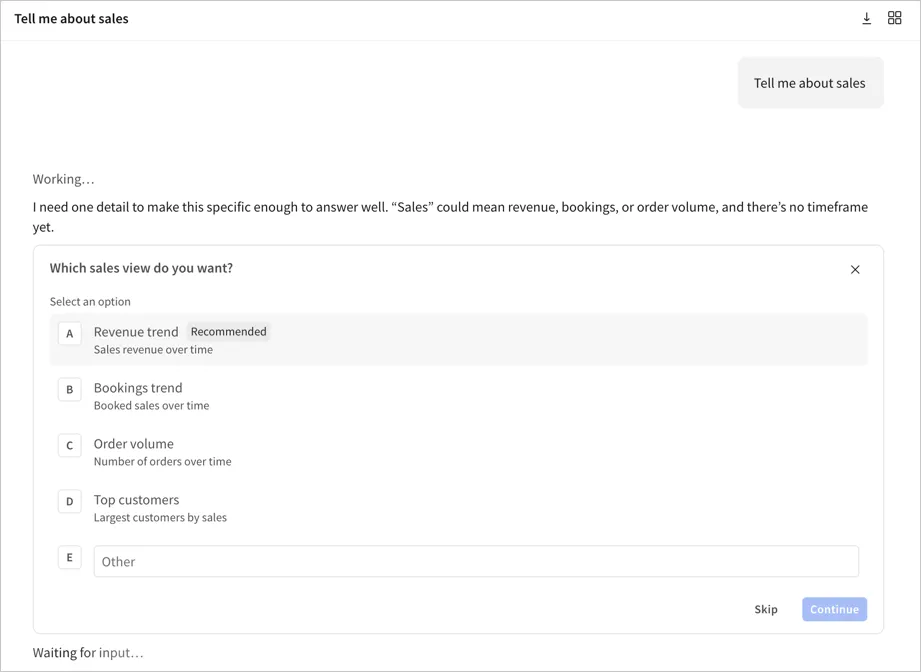
If your question is vague, Assistant might prompt you to clarify what you’re asking for before responding.
-
Sigma Assistant provides a response, along with a summary of its reasoning and how long it worked for.
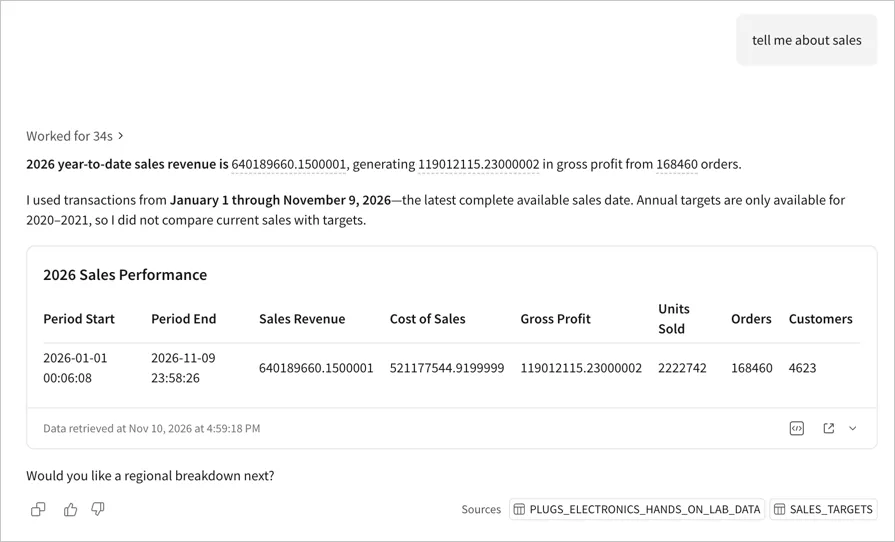
For more details, see Review and interact with a response.
-
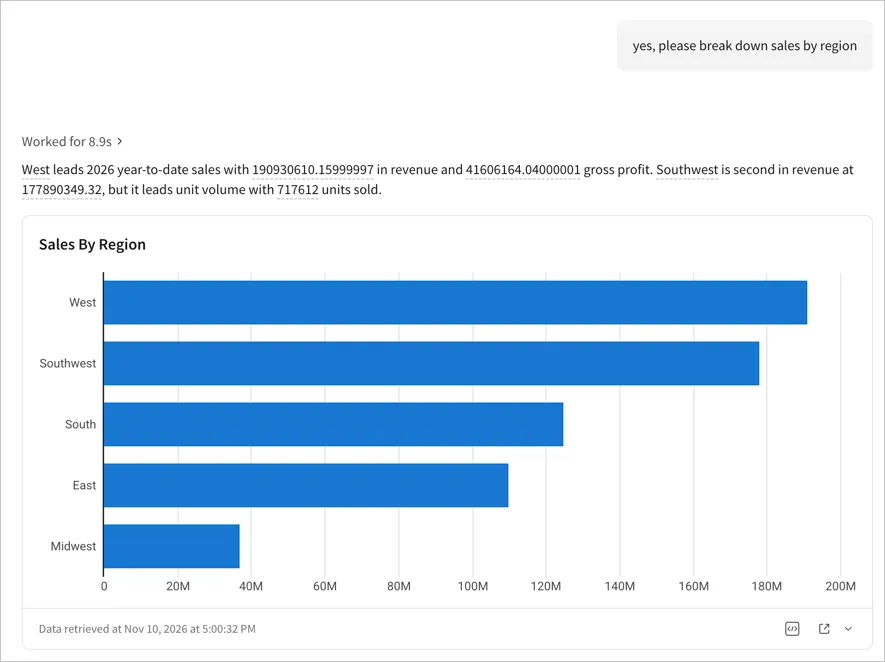
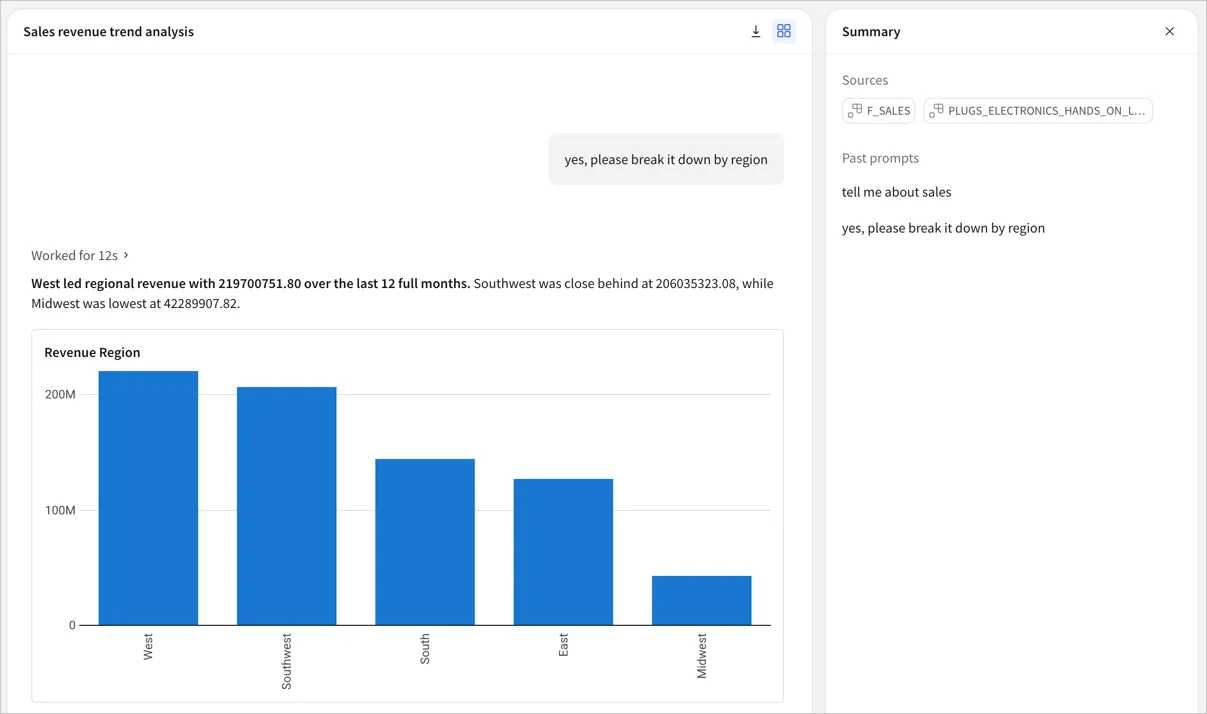
You can continue to ask follow-up questions to refine your analysis or understanding of the data source. Assistant also suggests possible follow-up questions to explore in your analysis. If Assistant is still responding to your previous message, your follow-up message is queued. For example, you might follow up and ask “Please break down sales by region”:
-
If you want to save the full conversation, in the chat header, select Export as PNG to download an image of the conversation.
-
If you think of an unrelated analysis that you want to perform in a different chat session, start a new chat:
- If chat history is turned on for your organization, in the sidebar, click Chat to start a new chat. At any time, you can return to a previous conversation from the list.
- If chat history is turned off for your organization, click Reset (
 ) to start a new conversation without leaving Sigma Assistant.
Review and interact with a response
After Assistant responds, you can check the data and analysis behind its answer, save results, or provide feedback.
The citation, analysis breakdown, and workbook actions described in this section apply when you select Sigma Assistant in the agent dropdown. For differences when using a warehouse agent, see Limitations with warehouse agents.
Check where an answer comes from (Beta)
This documentation describes one or more public beta features that are in development. Beta features are subject to quick, iterative changes; therefore the current user experience in the Sigma service can differ from the information provided in this page.
This page should not be considered official published documentation until Sigma removes this notice and the beta flag on the corresponding feature(s) in the Sigma service. For the full beta feature disclaimer, see Beta features.
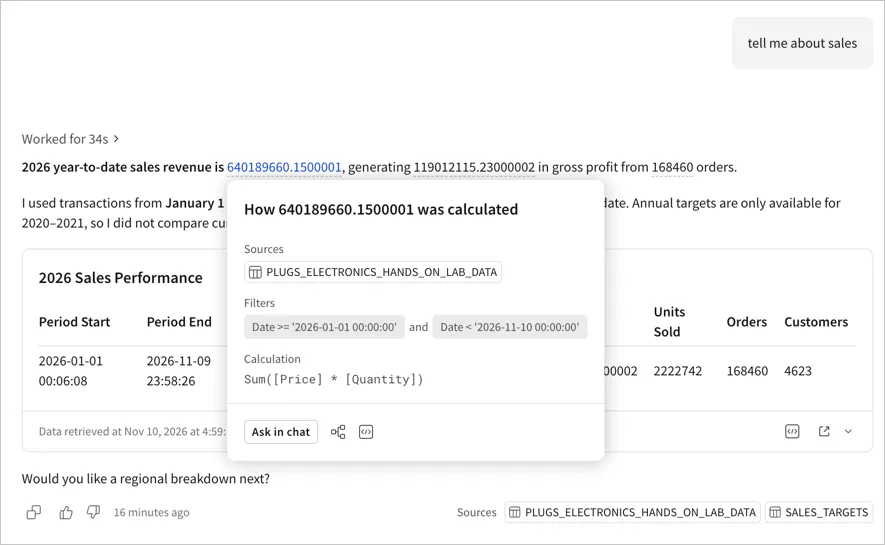
Before you use an answer in a decision or presentation, check where its values come from. Contextual citations link values in Assistant responses to the query results that support them. For example, before you share a year-to-date revenue total, check that it uses the expected sales source, reporting period, and definition of revenue.
To check a cited revenue value:
-
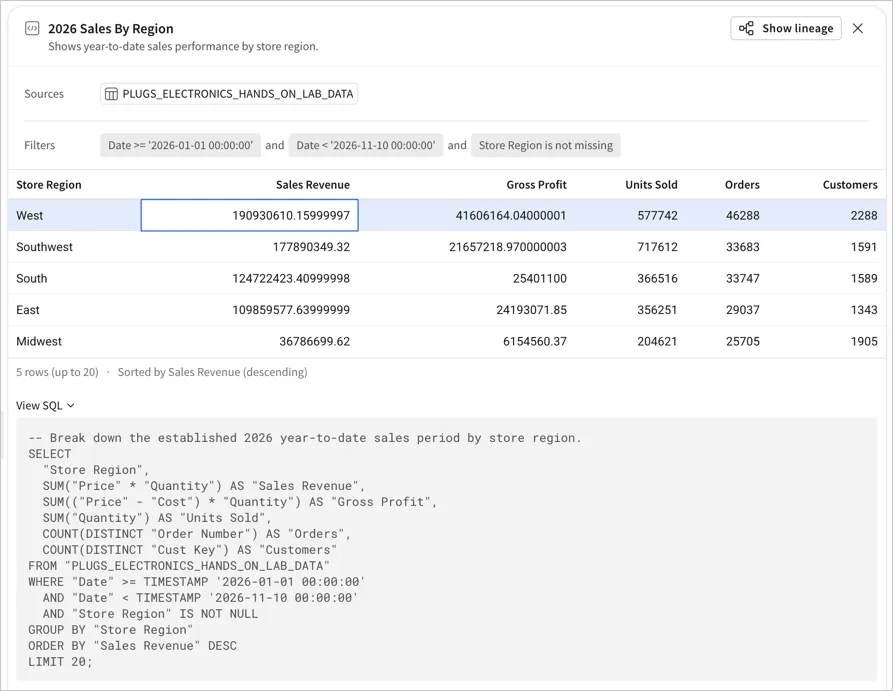
In the response, hover over the revenue value with a dashed underline to preview how Assistant calculated it. Review the sources, filters, and calculation when available. For example, check that the date filter covers the intended period and that the calculation matches your definition of revenue.
-
Select the cited value to open the query results in the summary panel and compare them with the answer. If the citation identifies a specific result cell, Assistant highlights that cell. You can also open the query results from Show details in the citation preview.
-
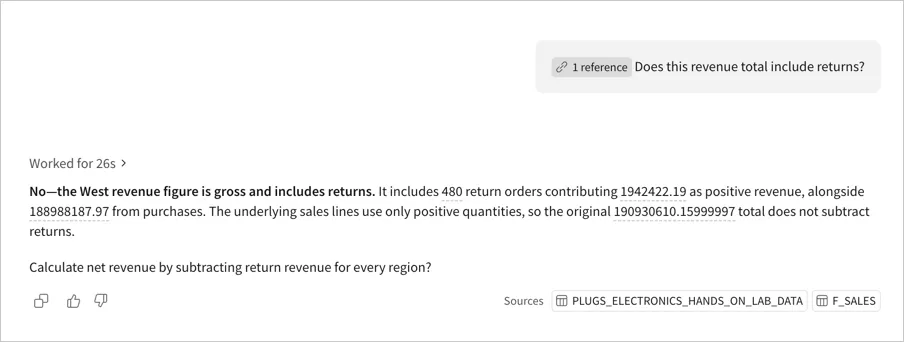
To clarify the value or request a revised analysis, hover over the cited value again. In the citation preview, select Ask in chat. Assistant adds a reference to the value to your prompt. Enter a follow-up question, such as “Does this revenue total include returns?” or “Recalculate this revenue excluding returns”, then send the prompt.
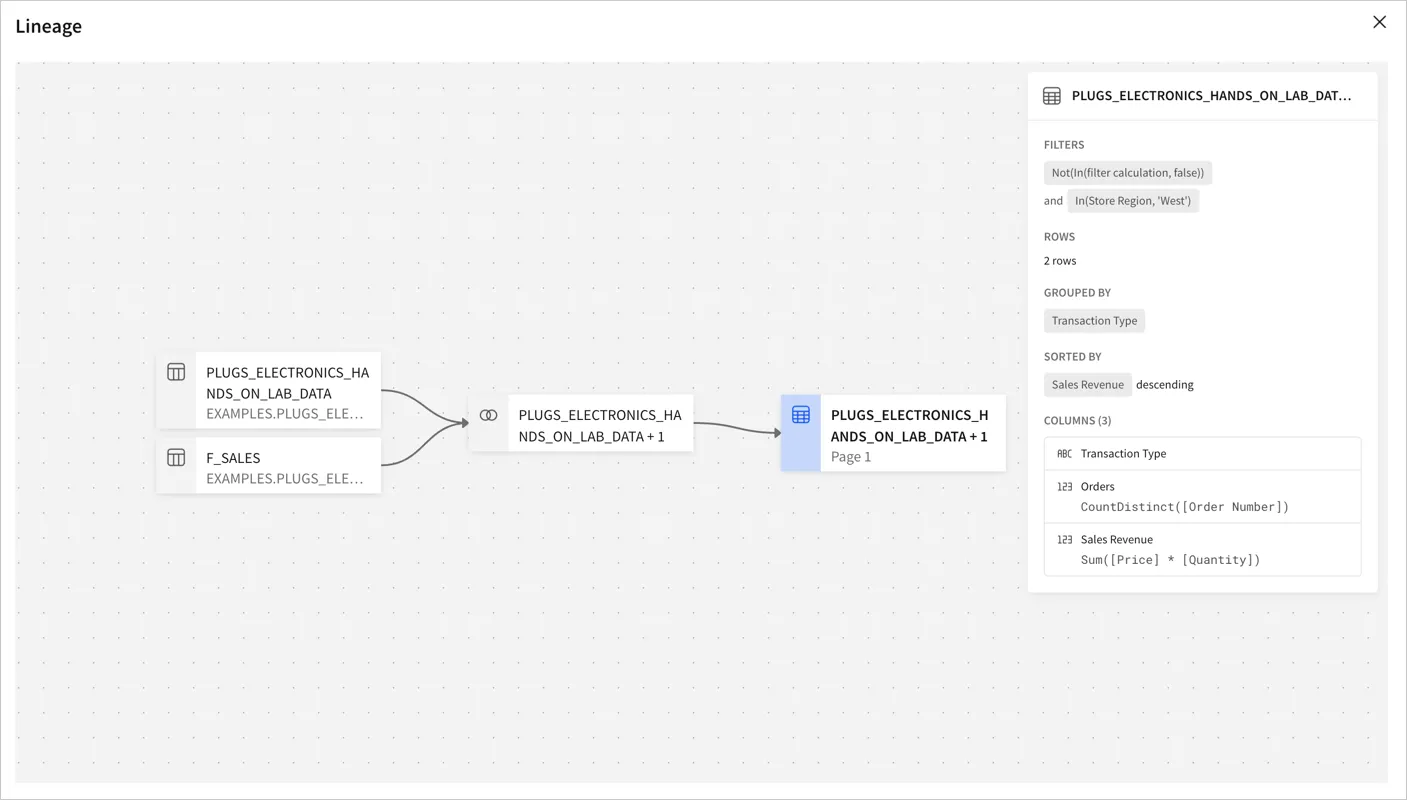
To inspect the source data, in the citation preview, select a source. To trace how the source data contributes to the result, select Lineage.
Understand how Assistant answered your question (Beta)
This documentation describes one or more public beta features that are in development. Beta features are subject to quick, iterative changes; therefore the current user experience in the Sigma service can differ from the information provided in this page.
This page should not be considered official published documentation until Sigma removes this notice and the beta flag on the corresponding feature(s) in the Sigma service. For the full beta feature disclaimer, see Beta features.
If the revenue total differs from another report, review the analysis breakdown to check whether Assistant interpreted your question as intended. Use the breakdown to identify differences in the data or calculations before you rely on the answer.
To review the analysis behind the revenue total:
-
In the response, select Worked for… to expand the actions Assistant performed.
-
If the details group multiple queries under Gathered data from…, expand the group. Select the query for the revenue total to open its results in the summary panel.
-
In the query details, compare the sources and filters with those in the other report. Review joins or unions when present. If a list shows additional items, expand it to review the remaining details.
-
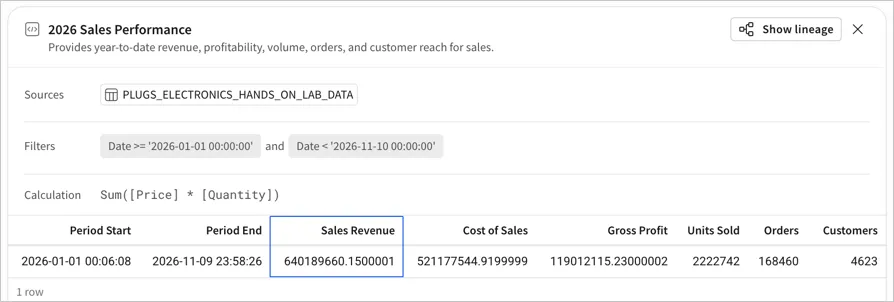
To check the calculation for a result column, select its column header. When a column definition is available, Assistant shows its calculation or metric reference.
-
To inspect the exact query Assistant sent to your data platform, select View SQL. To trace the source data and transformations, select Show lineage.
If the analysis differs from your intended request, ask a follow-up question that specifies the source, filters, or calculation to use. For example, ask “Use the sales data model to calculate year-to-date revenue, excluding returns”.
Interact with charts and tables
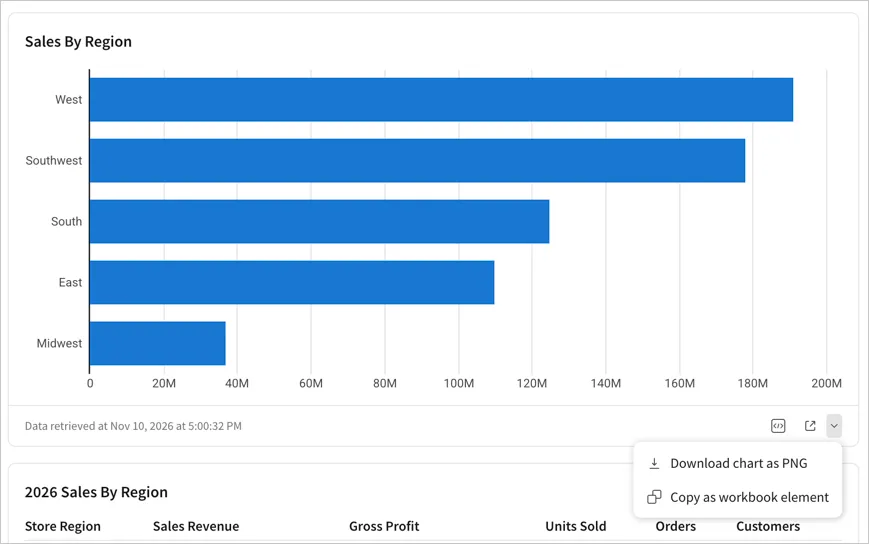
When Assistant includes a chart or query-result table in a response, use the actions in the card footer to inspect the result, continue your analysis, or save it for later. The available actions depend on the result and your permissions.
When a card includes a Data retrieved at timestamp, use it to check when Assistant retrieved the data for that result.
You don’t need the Download permission to download a PNG of a chart or table.
Copy a response and provide feedback
-
Click (Copy response) to copy the response to share with someone else.
-
To provide feedback to Sigma about the quality of the response from Assistant, select (Good response) or (Bad response). If you select Bad response, optionally provide details about what was wrong. Only the feedback details are shared with Sigma. Details about your conversation with Assistant are not provided to Sigma.
Admins can also review scores and feedback for Sigma Assistant interactions in the AI usage table. See AI usage dashboard.
Review a summary of source details and your conversation
At any point in your conversation, you can select (Show summary panel) to display a summary of your conversation:
- Review the sources used by Assistant throughout your conversation. Select a source to preview the data and confirm it is the relevant source. When previewing a source, click Open table or Open data model () to open the source in a new tab.
- Review your past prompts in the conversation. Select a prompt to review the response to that prompt in the summary panel. For example, you can compare different responses side by side from your analysis.
Use voice input
You can dictate your initial question or a follow-up message to Sigma Assistant. For example, explain which metric you want to investigate and how you want to break down the results.
-
In the prompt bar, select Dictate.
-
If your browser prompts you for microphone access, allow it.
Sigma never receives your audio. Sigma only receives the transcribed prompt text, as edited and sent by you, and processes it in the same manner as any other typed prompt.
-
Speak your request. A waveform shows microphone activity, and recognized speech appears in the prompt bar.
-
When you finish speaking your prompt, select Stop dictating. You can’t type a prompt while dictation is active.
-
After dictation stops, review and edit the transcribed text, then press Enter or select Send .
Voice input requires a browser that supports speech recognition and microphone access, and is supported in Google Chrome, Microsoft Edge, and Apple Safari. The settings that control speech recognition, microphone access, and how your audio is handled are provided by your browser, not Sigma, and use your browser’s language setting. You can configure these settings directly in your browser. For instance, if you configure your browser to deny microphone access, voice input is not available.
Voice input is optional, and its use is solely at your discretion.
By using voice input, you understand and acknowledge that:
- Your audio and the transcript produced from it, may be collected and processed by your browser and its speech transcription service. Sigma has no visibility into or control over how they handle your information, including whether your audio leaves your device, how long it is kept, and whether it is used to improve their services.
- Before using voice input, you should review the terms and privacy notices for your browser and its speech transcription service.
Search and explore data sources
Sigma Assistant has access to all data sources that you can access in your organization by default, unless an admin has selected specific sources for Assistant to use first. If you know exactly which data source you want to ask questions of, you can select it before asking questions with Sigma Assistant:
-
From Sigma Home, click Chat.
-
Select +, then search for one of the following data sources that you can access:
- Table in your data platform
- Published version of a data model, or a specific element within it
Sigma returns all matching tables and data models that you have access to use. If your admin has selected specific sources for Assistant, those sources include an indicator.
All data access grants that apply elsewhere in Sigma also apply in Sigma Assistant. For example, if row-level security or column-level security is applied to a data source, Sigma Assistant only works with data that you have access to. For a data model, you must have access to the published version.
Your admin can select sources to be used by Sigma Assistant by default.
Interact with warehouse agents in Sigma Assistant
When you ask questions of Sigma Assistant, you can choose a Snowflake Cortex Agent or a Databricks Genie Agent in your organization to answer the questions. For setup steps, see Use warehouse agents with Sigma.
Requirements
If you chat with a warehouse agent instead of Assistant, an AI provider is not required.
- Using warehouse agents for Assistant must be turned on in the AI settings for your organization.
- You must be granted Can use access to the warehouse agent, schema, database or catalog, or connection that contains the agent.
- If you connect to Snowflake using OAuth and want to use a Snowflake Cortex Agent, your role must be granted USAGE privileges on the agent in Snowflake.
- If you connect to Databricks using OAuth and want to use a Databricks Genie Agent, your role must have CAN VIEW or CAN RUN on the Genie Agent in Databricks.
Each warehouse agent runs using the role configured in the connection to the data platform. For details, see Use warehouse agents with Sigma.
Ask natural language queries of a Snowflake Cortex Agent
In Sigma Assistant, ask natural language queries using a specific Snowflake Cortex Agent:
-
From Sigma Home, click Chat.
-
In the agent dropdown, choose a warehouse agent that you have access to. Sigma Assistant is selected by default.
-
In the Ask me anything about your data box, enter your question.
-
Sigma Assistant provides a response.
You can continue interacting with Sigma Assistant. See Ask natural language queries with Sigma Assistant.
Limitations with warehouse agents
When using a Snowflake Cortex Agent or Databricks Genie Agent with Sigma Assistant, the following limitations apply:
- Contextual citations, analysis breakdowns, Open in workbook, and Copy as workbook element aren’t available for responses from warehouse agents. For supported charts, Download chart as PNG remains available.
- Asking questions about a data source is not available.
- Questions about data modeled in Sigma, such as a data model defined in Sigma, or a metric defined on a table in Sigma, cannot be accurately answered. A warehouse agent has access only to the data in your data platform.
- Databricks Genie Agents cannot create charts.
Manage chat conversations
Access and manage recent chats
If chat history is enabled for your organization, you can view, resume, rename, and delete your own recent chats with Sigma Assistant. The retention period depends on your organization’s chat history settings.
The Recent chats list in the following steps includes chats with Assistant on the homepage. For information about accessing your recent chats with Assistant in the workbook, see Use Sigma Assistant to explore and analyze workbook data and Use Sigma Assistant to build dashboards and apps.
In the Chat section of the home page navigation panel, scroll the list of recent chats, then complete any of the following tasks:
- To view or resume a chat, select it from the list. Sigma reopens it where you left off.
- To rename a chat, click More next to the current chat name, then select Rename. Edit the name inline and press Enter.
- To delete a chat, click More next to the chat name, then select Delete. The chat is immediately deleted from your recent chats, but admins can still review it in the AI usage dashboard.
- To start a new chat, select New chat. Sigma closes the current chat and opens a new one.