

Create and configure a drill down control
A drill down control lets users drill through a predefined path of columns, called drill categories, to explore one or more charts at different levels of detail. When you choose a category in the drill path, each chart targeted by the control updates to display the selected level of detail.
Use a drill down control when you want to give viewers a guided, repeatable way to drill into a chart, or when you want one drill path to control multiple charts at once.
Any user with Can edit or Can explore access to a workbook can already drill into a chart ad hoc, without a control, by right clicking on a chart and selecting Drill down from the context menu. A drill down control extends that same drill down behavior to users with Can view access, but only along the specific columns you choose as drill categories.
Limitations
- A drill down control can only target the following chart types: bar, line, area, scatter, combo, box and whisker, donut, funnel, and treemap. You can’t target other data elements or charts, such as pivot tables, tables, KPI, gauge, Sankey, waterfall charts, or any map visualizations.
- If a column used in a drill category or a target is later renamed or removed from the underlying data, the control displays Invalid Source Column instead of updating automatically. To fix an invalid source column, remove and re-add the affected drill category or target.
- Changing the value source of a drill down control resets the current value and removes any custom control name.
- You cannot set a drill down control as Required.
User requirements
- To create or configure a drill down control, you must have Can edit access to the workbook.
Add a drill down control
-
In the Add element bar, choose Controls > Drill down.
The new control appears on the canvas.
If you’ve already drilled into a chart and want to turn that drill path into a reusable control, see Create a drill down control from an existing drill path.
Configure the control
Configure the drill down control to specify categories that a user can use to interact with one or more charts, and to specify the charts targeted by the control.
Select a value source and add drill categories
Set up the drill categories for the control:
-
Select the control, then in Properties, click Settings.
-
For Value source, select a data element containing the columns that you want to use for the drill path.
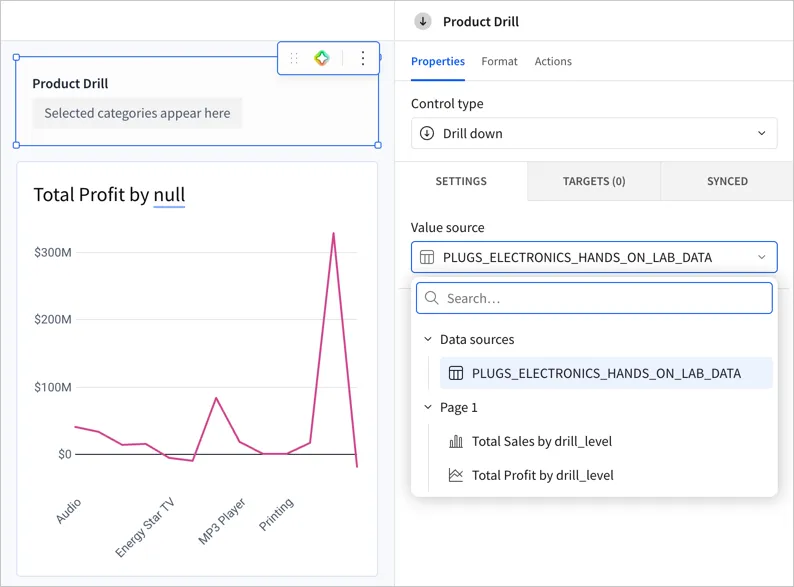
If the selected value source is a chart that already has an active drill path (for example, one created with Drill down into data), Sigma automatically adds that chart’s current drill column as the first entry under Drill categories.
-
For Drill categories, click + Add drill category.
-
Select a column from the list.
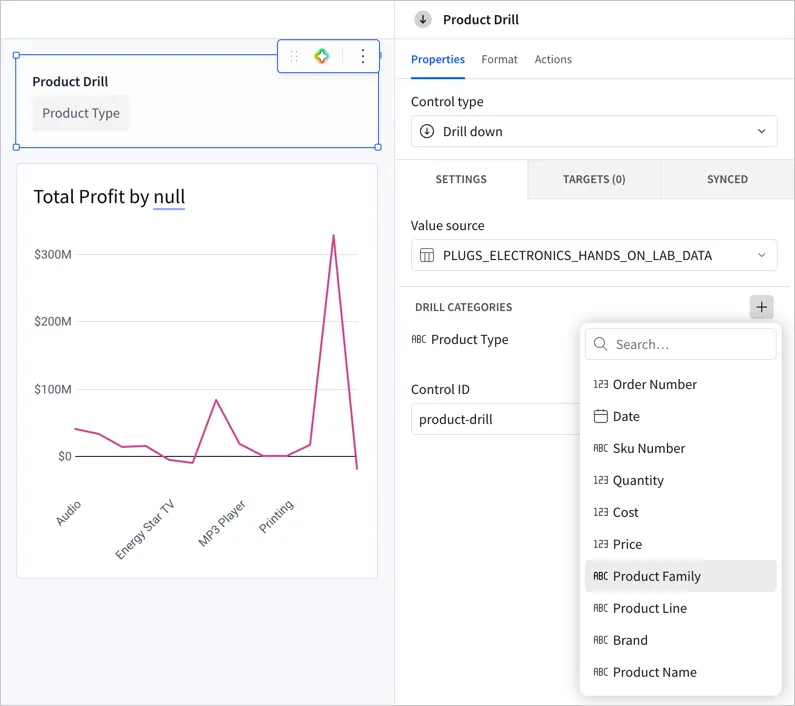
-
(Optional) To add more columns to your drill path, repeat steps 3 and 4. Drag a drill category to reorder it. The control displays each category in order along its drill path.
Specify the target of the control
After configuring the value source of the drill down control, choose which charts to update when a user drills into a selected category by specifying the charts as control targets.
-
Select the control, then in Properties, click Targets.
-
Click + Add drill target.
-
Select a target chart from the list. Only chart types that support drilling appear as options.
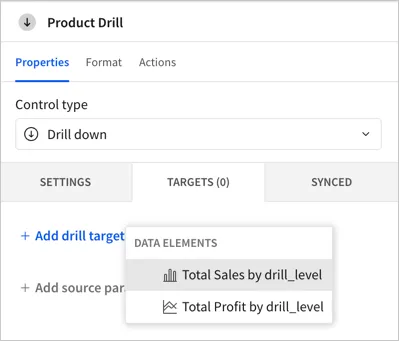
-
In the Map with columns in target section, use the dropdown menus to map each drill category to the corresponding column in the target chart. Sigma automatically maps any columns that match by name.
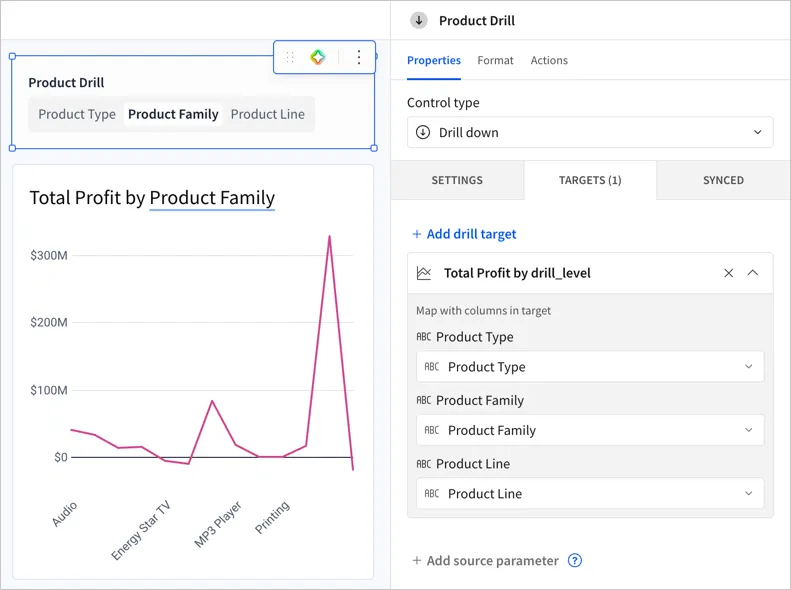
-
Repeat the previous three steps to add additional targets.
-
To test the control, click a category name in the drill path to drill into that category. Confirm that every targeted chart updates accordingly.
-
(Optional) Update the Control ID to something more specific.
After configuring a drill down control to target a chart, any user with access to view that chart can use the control to drill into it.
Create a drill down control from an existing drill path
If you already drilled into a chart using Drill down into data, you can convert that drill path into a reusable, shareable control:
-
In a chart that you drilled into using drill down into data, right-click a value in the chart to open the context menu.
-
Select Drill up > Create drill control.
A drill control appears on the canvas that targets the chart and uses the chart as the value source. The drill categories for the control match the columns that you drilled through to get to the current view of the chart. If needed, configure the control to edit the value source, drill categories, and targets.
Format and design a drill down control
You can format and design the drill down control to match the styling of your workbook. To review and update the formatting options, select the control, then select the Format tab.
Update the element style
You can customize the style of the element, such as the background. See Customize element background and styles.
Update the control label
Customize element content alignment
In the Alignment section, you can customize the Vertical setting to reposition the element content relative to the total element height.