RegexpMatch
Returns True if a string matches a regular expression.
This function isn’t compatible with all data platform connections. To check if your connection supports it, see Supported data platforms and feature compatibility.
Syntax
Function arguments:
- string (required): The string to search.
- pattern (required): The pattern to match within the string.
When the regular expression you want to use contains a slash, quotation or other special character, you will need to use a backslash () to escape the special character.
Notes
- When any of the arguments are
Null, the function returnsNull. - Regular expressions vary by database. Check the documentation of your data platform for syntax.
Examples
Checks if a name starts with an uppercase letter, followed by one or more lowercase letters, and then has another uppercase letter followed by one or more lowercase letters.

Checks if a string matches the social security pattern ‘xxx-xx-xxxx’. Returns True.
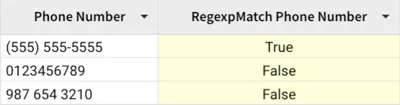
Checks if a string matches the phone number pattern ‘(xxx) xxx-xxxx’
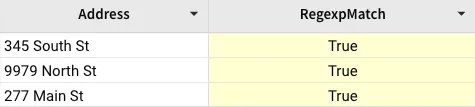
Checks if an address starts with numeric characters.