> For clean Markdown of any page, append .md to the page URL.
> For a complete documentation index, see https://help.sigmacomputing.com/llms.txt.
> For AI client integration (Claude Code, Cursor, etc.), connect to the MCP server at https://help.sigmacomputing.com/_mcp/server.
# Month
> Use the Sigma Month function to return an integer representing the month component of a specified date and time.
The **Month** function returns an integer representing the month component of a specified date and time.
## Syntax
```
Month(date, [timezone])
```
The Month function has the following arguments:
-
date
-
Required
-
The date or the column that contains date values where Sigma extracts the month component
-
timezone
-
Optional
-
The
IANA time zone
; for example, (e.g.,
“America/Los_Angeles”
, used to convert the date value before extracting the month component.
-
When omitted,
timezone
Sigma evaluates the date in UTC time.
## Examples
```
Month(Date("2007-08-14"))
```
Extracts the month component from the specified date (August 14, 2007) and returns `8` to represent the eighth month of the year.
```
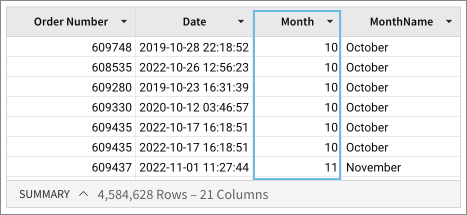
Month([Date])
```
The **Month** function returns the following values for the **Date** column:
## Related resources
* [MonthName](/docs/monthname)
* [DatePart](/docs/datepart)
* [Second](/docs/second)
* [Minute](/docs/minute)
* [Quarter](/docs/quarter)
* [Year](/docs/year)
*
Quickstart: Common date functions and use cases